November 27, 2026
WHAT IS ASSOULINE? THE PUBLISHER THAT TURNED BOOKS INTO A LUXURY BRAND
Those bright city books on hotel coffee tables all come from one publisher. Here is what Assouline is, what it makes and how a book became a luxury object.
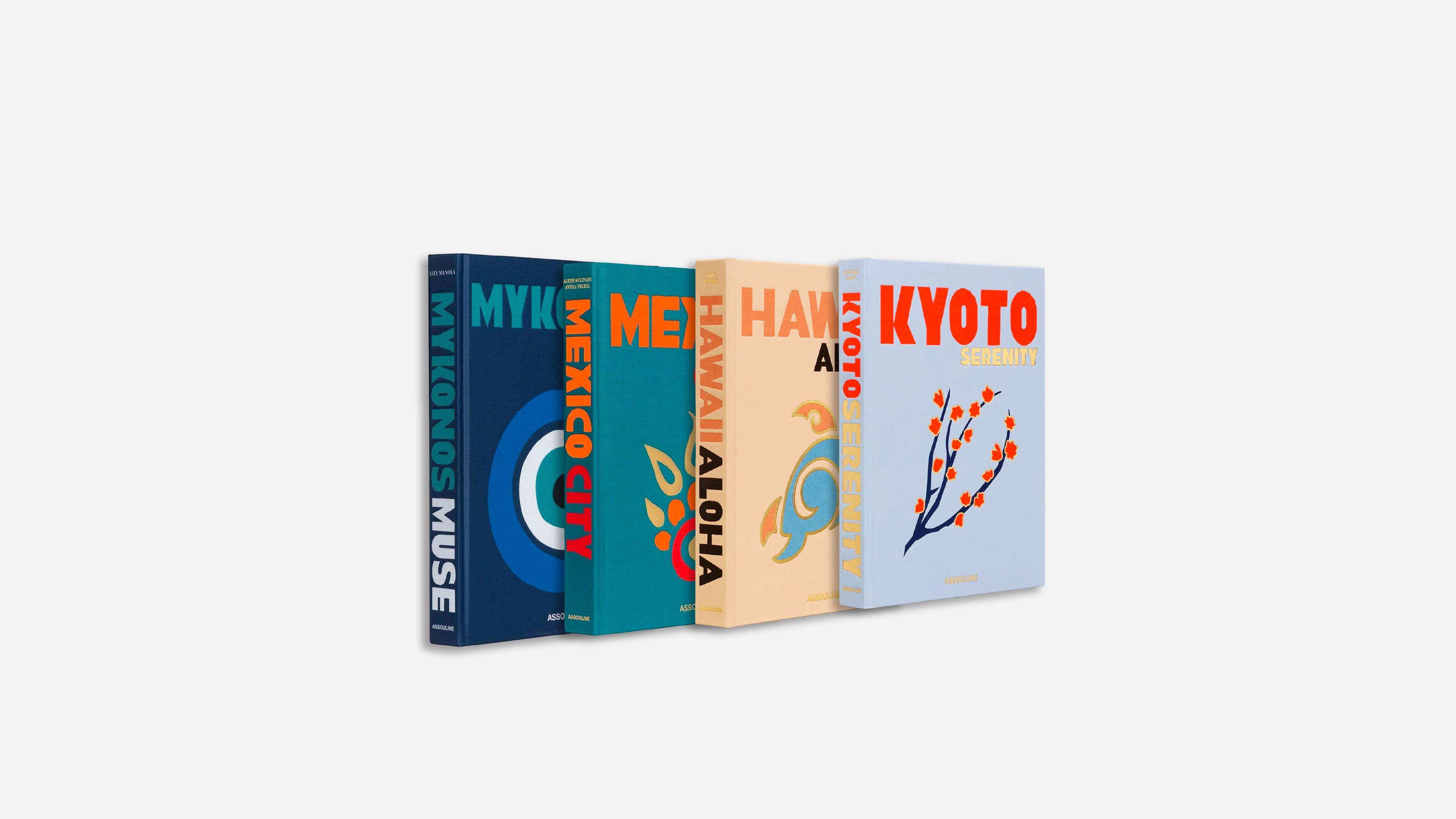
You have probably seen one before you knew the name. A stack of hardcovers in a hotel lobby, each cover a different burst of color and illustration: Mykonos, Marrakech, Lake Como, Mexico City. They sit face up on coffee tables, show up in the background of interior photos and end up in more than a few vacation posts. They are Assouline books, and the publisher behind them has spent three decades proving that a book can be a design object, a souvenir and a signal of taste at the same time.
So, what is Assouline? It is a luxury publisher founded in Paris in 1994 by Prosper and Martine Assouline and headquartered in New York since 2007. It publishes illustrated books on travel, fashion, art, design and culture, and sells them through its own boutiques, partner retailers and a growing line of objects designed to live next to the books. Here is how it got there, what it actually makes and what its best-known series shows about editorial design.
From one hotel to a publishing house
The first Assouline book was a personal project. After a 1993 stay at La Colombe d'Or, a hotel in the South of France, the couple decided to make a book about it. Prosper took the photographs, Martine wrote the text, and La Colombe d'Or came out in 1994. The company started as a family operation working out of the basement of their Paris apartment.
Two years later came the Memoir Collection, a series on influential figures and houses in fashion, art and design, including Alaïa, Chanel, Vionnet and Dior, eventually translated into ten languages. That collection set a pattern the publisher still follows: a consistent format, a recognizable subject and a book that feels like an extension of the name on its cover.
The business grew from there. Assouline opened its global headquarters in New York in 2007, LVMH acquired a minority stake in 2013, and by 2020 the catalog had passed 1,700 titles. In January 2025, Alexandre Assouline, the founders' son, was named president.
The collections, explained
The catalog is easier to understand as a set of product lines than as a list of titles. A few of them carry most of the identity.
The Travel Series. Books about cities, islands and destinations, from Ibiza to Cairo. They are the most visible Assouline books and the ones most people picture when they hear the name. More on them below.
The Impossible Collection. Oversized, handmade volumes, each built around a single subject. The first, on art, arrived in 2010, made in Italy with a clamshell case (a hinged box that fully encloses the book) and hand-stitched binding. The wine edition in 2016 pushed further, with a cork cover and a wooden crate. Here the binding and packaging are part of the content, and prices reach collector territory.
XXL editions. Larger-format editions, introduced in 2019, for readers who want the coffee table book to take over the whole coffee table.
Brand books. A significant part of the catalog is made with or about other companies. In 2026 alone, Assouline published a book celebrating eighty years of Vespa, released alongside a collectible helmet in the publisher's signature red, and a Nutella book for World Nutella Day. For the brands involved, a book like this is heritage storytelling with a very long shelf life.
Why the city books became the icon
The Travel Series is younger than its fame suggests. The first title was published in 2017, with cover artwork hand-drawn by Martine Assouline, and the series now includes more than thirty destinations. In the online store, city titles appear both under the Travel Series name and as part of The Classics Collection, at around €105 each in the European store. One of them is Mexico City, which, as a studio based there, we find hard to ignore.
A handful of editorial decisions explain why these books travel so well, both literally and online.
The cover is the identity. Each destination gets its own palette and illustration, while the format and overall layout stay consistent. That is how a series behaves like a brand system: every new title is instantly recognizable as Assouline, yet different enough to make you want the next one. On a shelf, the variety reads as a set rather than as clutter.
Image selection does the storytelling. The books are mostly photographic. Martine Assouline selects the images from thousands, sourced from dozens of photographers working across different decades. Mixing archival and contemporary photography gives each place a sense of history and mood, closer to a portrait of a destination than a guide to it. The text supports the pictures; nobody buys these books to find out where to have lunch.
They are designed to be displayed. A travel guide lives in a bag and gets worn out. These are large hardcovers that look good closed, open and in a photograph. That is a big part of why they spread so easily online: every time someone shares a shelf, a hotel room or a vacation flat lay, the cover does the marketing. It is a very different model from a publisher like Victionary, whose design books are meant to be used and finished, and both approaches are valid answers to the question of what a book is for.
They are easy to give. A book about a place someone loves, or has just visited, works as a souvenir, a gift and a piece of decor at once. The series turns a personal memory into an object with a clear look and a clear price point.
A publisher that behaves like a luxury house
Assouline has built a whole environment around its books. In 2003, Bergdorf Goodman gave it a Fifth Avenue window and a corner of its seventh floor in New York. Its first standalone boutique opened in Saint-Germain-des-Prés in 2006, and in 2014 Maison Assouline opened on Piccadilly in London, bringing the full brand together for the first time, with Swans Bar as its first hospitality concept.
Then came products that are not books at all. Home fragrances inspired by the Travel Series arrived in 2023. In 2024, Pantone released an Assouline Red shade, recognizing a long creative partnership. In 2025, the Library Collection added objects and home fragrances meant to turn a personal library into something closer to a curated room.
None of this is accidental. The same cues that make luxury websites feel expensive (restraint, consistency and attention to detail) show up here in physical form. And the company has been explicit about the positioning. In 2024, Alexandre Assouline summed it up in a WWD interview: "We're not a publisher. We're a luxury brand."
What Assouline shows about editorial design
You do not need a Piccadilly flagship to take something useful from Assouline. Three ideas apply to almost any brand considering a printed piece:
- Design the series, then the title. A fixed format with one variable element (color, illustration, subject) makes each new book easier to produce and easier to recognize, and turns a catalog into a collection.
- Treat the cover as the identity. If a book will be seen more often than it is read, the cover and spine carry the brand. That changes how you brief typography, color and finishing.
- Let production carry meaning. Binding, cases, paper and size are part of the message. A cork cover on a wine book says something before the first page is turned.
It is the kind of thinking behind Oryon, our sister editorial brand, whose identity and website we designed around the idea of books and objects worth keeping.
Assouline's success comes from accepting how its books are actually used. Most of them will be looked at far more often than they are read, and every decision, from the hand-drawn cover to the wooden crate, is made with that in mind. For anyone designing something printed, it is a good question to start with: where will this object live, and who will see it there?
From our work